
《岩戸神楽ノ起顕》
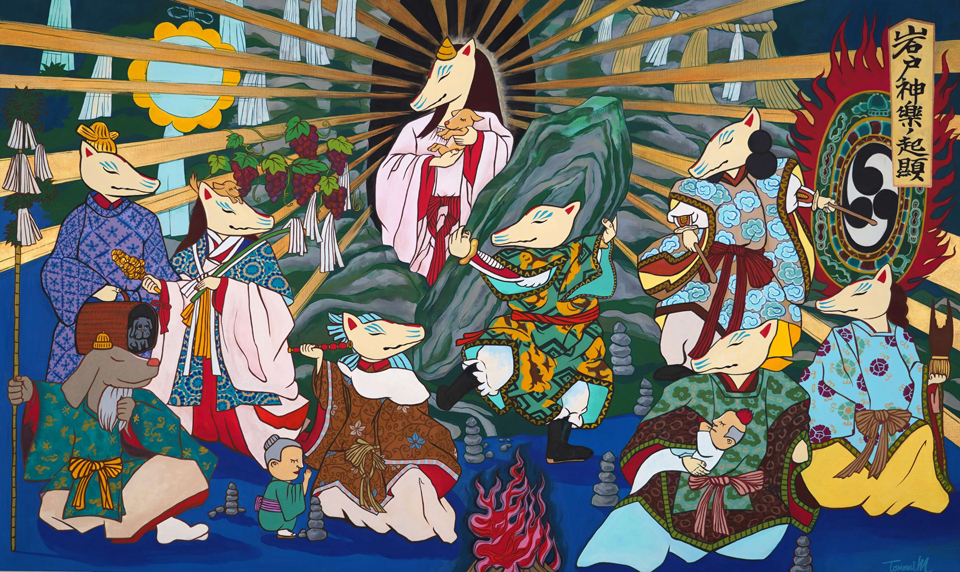
Artist’s Note
神話の物語を理解しきらないまま、形と配置だけをなぞるように描いた作品。
意味よりも、行為と時間の痕跡に関心がある。
This work was made by tracing the forms and spatial arrangements of myth without fully understanding its narrative. Rather than meaning, my interest lies in gestures and the traces of time that remain after meaning has faded.
――――――――――――――――――
批評草稿(試論)Critical Draft (Essay)
《岩戸神楽ノ起顕》について On Iwato Kagura: Emergence
本作《岩戸神楽ノ起顕》は、天岩戸神話という広く共有された物語を参照しながらも、その物語を再現したり解釈したりすることを目的としていないように見える。むしろここで描かれているのは、神話が成立するために必要だった配置や行為が、意味を失効させた後もなお残り続けている状態である。
画面に登場する神々は、いずれも同一の白狐の顔を持ち、個別の人格や序列は曖昧にされている。神は意志や感情を持つ主体としてではなく、人間、動物、時間、信仰が交差してしまう地点として配置されているように見える。その中に一匹だけ混ざる老いた犬の存在は、特別視されることも排除されることもなく、時間を帯びたまま、ただ混在している。
左側には、子犬をバッグに入れて通り過ぎる人物が描かれている。彼らは神話的出来事に関与するわけでも、儀礼に参加するわけでもなく、ただ日常の延長としてそこを横切っている。この配置によって、神話は閉じた物語空間ではなく、現実と混線したまま存在していることが示される。
本来、怒りによって岩戸に隠れたとされる天照大神は、この画面ではすでに時間が経過した後の存在として描かれている。引きずり出されるのでも、使命を果たすのでもなく、子犬との時間に没入し、引きこもった理由すら忘れてしまったかのような佇まいで現れる。そこには救済の構造も、物語的因果も前景化されていない。
画面の各所に残る石の積み上げは、かつて祈りや儀礼が行われた痕跡として存在している。しかし、それが何のためであったのか、どのような意味を持っていたのかは、もはや回収されない。祈りは行為として続いていたが、その中心は空洞化している。
本作は神話を批判するでも、更新するでもない。意味や使命が失効した後も、形式、行為、配置だけが惰性のように残り続けている状態を、そのまま視覚化している。そこでは老いも幼さも、神も人も動物も、明確な役割を与えられないまま共存している。この読みは暫定的なものであり、別の文脈から書き換えられる余地を十分に残している。
Iwato Kagura: Emergence does not appear to aim at a retelling or reinterpretation of the well-known myth of Amaterasu and the Heavenly Rock Cave. Rather, the work seems to attend to what remains after the narrative force of myth has dissipated: the persistence of arrangements, gestures, and ritualized actions once their original meanings have fallen into suspension.
The figures identified as gods all share the same white fox face, a choice that deliberately blurs individuality, hierarchy, and divine personality. Here, divinity is not presented as a set of distinct beings endowed with will or emotion, but as a site of convergence—a crossroads where humans, animals, time, belief, and custom intersect. Within this undifferentiated group, a single aged dog appears, neither emphasized nor excluded, carrying the visible weight of time while remaining simply embedded among the others.
On the left side of the composition, two figures pass by with a puppy placed inside a bag. They do not participate in ritual, nor do they acknowledge the mythic event unfolding nearby. Their presence introduces an everyday temporality that cuts across the sacred scene, suggesting that myth does not exist in a sealed narrative space but remains entangled with ordinary movement and contingency.
Amaterasu herself is depicted not at the moment of dramatic withdrawal or triumphant return, but at a point after time has already passed. She is neither coerced nor summoned back by ritual obligation. Absorbed in her time with a puppy, she appears to have forgotten the reason for her seclusion altogether. The familiar structure of cause and resolution that underpins the myth is thus quietly neutralized.
Throughout the scene, traces of accumulated stones remain as evidence of past prayer and ritual labor. These gestures have taken place, yet their purpose is no longer retrievable. What endures is not belief as conviction, but action as residue. The center of meaning has hollowed out, leaving behind only form, repetition, and spatial arrangement.
The work neither critiques nor revitalizes myth. Instead, it renders visible a condition in which meaning, mission, and justification have expired, while ritual forms and collective behaviors continue through inertia. Old age and childhood, gods and humans, animals and symbols coexist without stable roles or moral hierarchy. This reading remains provisional, open to revision from other historical, cultural, or religious perspectives.
――――――――――――――――――
編集注 Editorial Note
本テキストは、作者との対話およびAIによる外部視点の生成を通じて構成された批評的試論である。
結論を固定するものではなく、再解釈や対話のための入口として公開している。
This text is a provisional critical essay generated through dialogue with the artist and the use of AI as an external interpretive lens.
It does not seek to fix meaning, but to serve as an entry point for further reading and reinterpretation.